Assembly of European Horticultural Regions

EU projects

CURRENT EU PROJECTS

At the moment AREFLH is a partner in the following projects

  • Waste4Soil : on developping technological and methodological solutions for recycling food processing residues from the food industry into local, bio-based circular soil improvers (2023-2027)
  • LivingSoiLL : "healthy Soil to Permanent Crops Living Labs", the project focuses on: vinyards, olives, chestnuts, hazelnuts and apples. (2024-2028)


FINISHED EU PROJECTS

  • Novasoil : Innovative Business models for soil health (2020-2025)
  • Low in Food (2020-2025): co-designing low-waste value chains by supporting the demonstration of a portfolio of innovations in the fruits & vegetables, bakery products and fish value chains.
  • SmartProtect : thematic network focusing on cross-regional knowledge sharing of SMART IPM solutions for farmers and advisors. 
  • CuteSolar : Cultivating the Taste of European in Solar Greenhouses.
  • Console : “CONtract SOLutions for Effective and lasting delivery of agri-environmental-climate public goods by EU agriculture and forestry".
  • Nutriman : Nutrient Management and Nutrient Recovery Thematic Network

  • EUFRUIT Thematic Network

  • Efood Chain (ICT)

  • ECO ZEO

  • Programme de promotion IGP-AOP

  • Precirieg

EUFRUIT is an EC H2020 funded, three year project to establish a framework and a systematic approach that together bridge the ‘valley of death’ for the European fruit sector by taking a multi-actor approach and thereby increasing the connectivity and efficiency between research outcomes and implementation of knowledge and outcomes.

The project consortium consists of 21 members, including research institutes, universities, and industrial partners who represent key parts of the fruit supply chain, from 12 European countries.
 

More information on : http://eufrin.org/index.php?id=55
tous logos eufruit

Project dates : 2011-2014


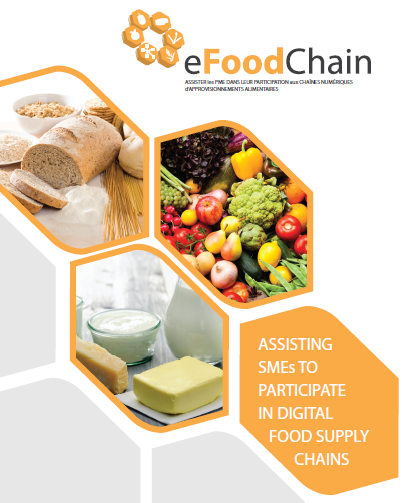
Assisting SMEs to participate in digital food supply chains.image brochure

The permanent need for innovation is one of the most important challenges faced by the agro-food sector. Innovation and new information technologies have become determining factors for its competitiveness and for strengthening exchanges with other sectors linked to it. Innovation requires better collaboration not only between the public and private sector but also between different business sectors. In this respect an increased use of ICT and the emergence of innovative B2B (business-to-business) services can help achieve this goal.

The eFood Chain Solution

The eFood Chain project was an important step towards the promotion of innovation in the food supply chain. Its main goal was to improve the competitiveness and efficiency of this industry by stimulating an innovative and seamless use of ICT along its value chain. SMEs are at the centre of interest of this action, as it aims to facilitate their participation in global digital food value network and reinforce business relationships between SMEs and their business partners across borders.

Through its framework for a digital food supply chain the project was expected to identify and diminish the existing technical and organisational barriers, as its ultimate goal is to create an innovative, seamless eBusiness environment that will stimulate the uptake of ICT and eBusiness technologies in this highly SME-intensive sector.

The eFood Chain project’s key objectives were to:

  • Provide an in-depth market analysis in terms of the current use of ICT and eBusiness solutions in the agro-food sector.
  • Develop a framework for a digital food supply chain, which will set the principles and rules for interoperability among business processes and data exchange models in order to allow for seamless, paperless information and data flows.
  • Demonstrate the feasibility and validity of the framework through sectoral and cross-border pilot-prototypes.
  • Promote awareness raising and dissemination of the framework and the results achieved.
  • Establish a governance model for future maintenance of the framework and propose policy recommendations for mass market adoption. 


november update


NUTRIMAN (october 2020 update)

The latest meeting of the NUTIMAN project “NUTRIent management and Nutrient Recovery Thematic Network” was held on September 10 and 11 through videoconference due to the current COVID19 sanitary emergency.


The goal of the meeting was to provide a general overview of the activities carried out in the last twenty-four months of the project following the report sent by the European Commission as well as to plan the upcoming activities for the remaining twelve months of the project.


During the meeting the activities related to the survey on organic fertilizers were discussed. This is a participatory approach, involving end users from the beginning, which will ensure a greater willingness to adopt the results of the demonstration tests. During this period, semi-structured individual interviews were conducted with end users by region and type of agricultural production. In the following months the interviews will continue with the involvement of users interested in participating in the organic fertiliser survey.  At the end of the project the interviews will provide information on the willingness of farmers, farmers to adopt practices, products of the shortlist by implementing a behavioural approach, e.g. as in the theory of planned behaviour.


In addition, the participants also discussed activities related to the collection of practice-oriented knowledge for innovative nitrogen and phosphorus recovery technologies and products. So far more than 64 technologies and products have been identified, with the ambitious goal of reaching about 100. By the end of the project, the best 25 selected technologies and products will be translated into the eight languages provided by the project.


The project partners also discussed in detail the implementation of the next activities concerning the organisation of practical demonstrations at experimental stations, digital workshops and webinars that will all take place online, due to the current health situation of COVID-19.


NUTRIMAN is a thematic nitrogen and phosphorus network that gathers knowledge "Ready for practice" for such applications, practices, and technologies of recovered products, applied interconnection science, and industrial practice, for the interest of users and the benefits of agricultural professionals. The project aims are to improve the exploitation of the N/P nutrient management/recovery potential for cases without practice sufficiently known by professionals. This action will open up new opportunities for farmers to develop connections between applied research with the results of practical utility and agricultural practices in the priority area of ​​nutrient management and nutrient recovery.


For more information on the project, please visit: https://nutriman.net/

Register to the Nutriman newsletter: https://nutriman.net/subscribe


CONSOLE (October 2020 update)


AREFLH is a partner of the CONSOLE project – “CONtract SOLutions for Effective and lasting delivery of agri-environmental-climate public goods by EU agriculture and forestry" is a project that focuses on promoting innovation in the delivery of agri-environmental climate public goods by EU agriculture and forestry.


This month the CONSOLE project has developed a major Dissemination and Communication Strategy whose objective is to serve as a training plan for awareness raising activities, stakeholder information and dissemination of CONSOLE project results.


The objective of this plan is to ensure that the project has a structured and streamlined approach to communicate about the project using various tools. The plan will also describe the next tasks and how the project is expected to be exploited.


In order to achieve the proposed objectives, the CONSOLE project has designed a page (including logos, type of letters, corporate colours, etc.) that facilitates user navigation, but has also developed a comprehensive digital marketing strategy.


One of the keys to the communication and dissemination strategy is the use of the blog on the website, where publications are regularly published in a semi-automatic way on social networks (LinkedIn, Twitter, Facebook).


For more information you can consult the 6.1 deliverable.


SmartProtect (October 2020 update)


AREFLH is a partner of the project SmartProtect, a thematic network focusing on cross-regional knowledge sharing of SMART IPM solutions for farmers and advisors. IPM or Integrated Crop Protection is a tool to achieve sustainable crop production in European agricultural policy.


SMARTPROTECT is mainly a network which gathers and shares knowledge about intelligent IPM techniques across borders. In addition, innovation is being sought for vegetable cultivation. Precision farming and data analysis undoubtedly offer opportunities to integrate advanced technologies into the sector.


The project considers the specific regional needs of horticulturists across Europe. First of all, it maps the needs of horticulturists. Then it compares existing IPM techniques in their socio-economic and legal context. Finally, the project selects the techniques with the greatest innovative potential.


SmartProtect is an EU funded project under the Horizon 2020 programme. The new European research project SmartProtect started in January 2020.


For more information please visit:

AREFLH is a partner of the project SmartProtect, a thematic network focusing on cross-regional knowledge sharing of SMART IPM solutions for farmers and advisors. Its aim is to stimulate knowledge flow in the regional AKISs (Agriculture Knowledge and Innovation Systems) across the EU and connect these on the innovative potential of advanced methodologies for Integrated Pest Management (IPM) in vegetable production, integrating precision farming technologies and data analytics.

 logo smartprotect

The horticulture sector in EU-27 accounts for about 13.7% of the agricultural output which is nevertheless only a small percentage of the total acreage (around 3%). The vegetable sector is thus characterized by a high added value and as a provider of easily accessible jobs. This is acknowledged in the Horticulture report of the European parliament from 14 March 2014. Like in other agricultural subsectors, farmers in horticulture face the challenge of responding to the mandatory implementation of the principles of integrated pest management (IPM) as called for by Directive 2009/128/EC on the sustainable use of pesticides.


IPM means careful consideration of all available plant protection methods and subsequent integration of appropriate measures that discourage the development of populations of harmful organisms and keep the use of plant protection products and other forms of intervention to levels that are economically and ecologically justified while minimizing risks to human health and the environment. IPM emphasizes the growth of healthy crops with the least possible disruption to agro-ecosystems and encourages natural pest control mechanisms (definition of the European Commission). IPM stands for a holistic approach to plant health management, based on prevention, monitoring, and control.


Also, during recent years, increasing worry about food safety, with high quality and environmentally friendly vegetable production, has been highlighted. The rational and limited use of pesticides for pest and disease control is prominent to achieve this objective. The basic objective of SmartProtect project is to fill the knowledge gap between research and practical management concerning innovation in IPM-methodology in different crops in open field crops and greenhouses. 


SmartProtect is an EU funded project in the frame of the Horizon 2020 programme. The new European research project SmartProtect started in January 2020. 


Other SmartProtect articles

For more information please visit : 

H2020 logo 500px

This project has received funding from the European Union’s Horizon 2020 Research and Innovation Programme under Grant Agreement No. 862563.


AREFLH
110 Quai de Paludate
BP26
33800 Bordeaux
Réalisation et maintenance par